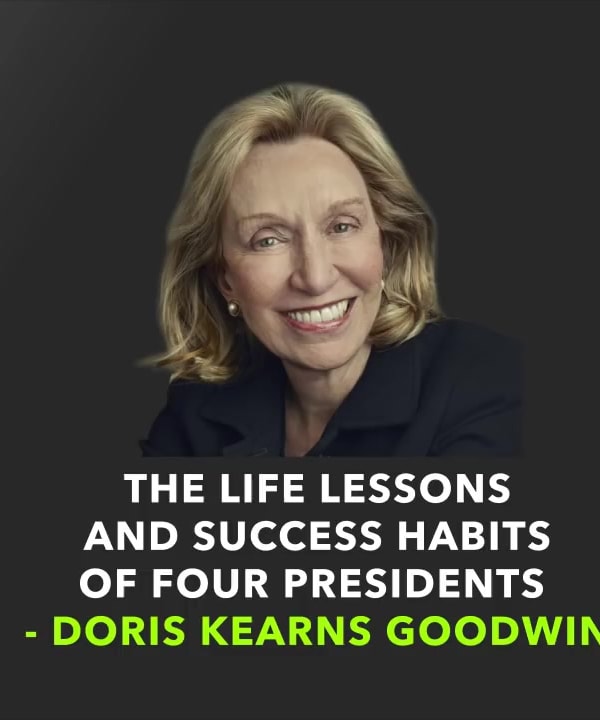
Interview with Doris Kearns Goodwin | The Tim Ferriss Show (Podcast)

Topics covered
Popular Clips




Questions from this episode
- Asked by 34 people
- Asked by 26 people
- Asked by 24 people
- Asked by 6 people
- Asked by 3 people
Episode Highlights
Lincoln's Temperament
Abraham Lincoln's leadership was profoundly shaped by his emotional intelligence and ability to forgive past grievances. recounts a story where Lincoln, despite being humiliated by Edwin Stanton, later appointed him as Secretary of War, showcasing his capacity to prioritize the greater good over personal feelings 1. This ability to forgive and collaborate with former rivals was admired by many, including , who sought Goodwin's insights on Lincoln's leadership style during his own presidential campaign 2.
I don't care if somebody disliked me or liked me in the past... If they're right at this time in this place, they're the right person for the time.
---
Lincoln's temperament, described as the greatest separator in presidential leadership, allowed him to unite and lead effectively during turbulent times.
FDR's Resilience
Franklin D. Roosevelt's resilience was evident in his ability to manage stress and maintain a balanced life. highlights FDR's routines, such as his daily cocktail hour where war discussions were banned, allowing him to unwind and recharge 3. His ability to detach from the pressures of leadership, like taking a fishing trip during a crisis, enabled him to think creatively and develop strategies like the Lend-Lease Act 4.
He really knew how to relax... the best thing he did was when he was in World War II, he had a cocktail hour every night.
---
These practices were crucial for maintaining his mental health and effectiveness as a leader.
LBJ's Influence
Lyndon B. Johnson's political influence during the civil rights era was marked by his ability to connect with people and navigate complex political landscapes. shares her personal experiences with Johnson, highlighting his persuasive nature and commitment to civil rights, despite their differences over the Vietnam War 5. His legacy includes significant contributions to the Great Society and civil rights, as well as his role in shaping major speeches and policies 6.
I did see extraordinary success that he had had in the Great Society and in civil rights.
---
Johnson's leadership was complex, balancing personal relationships with political ambitions to drive significant social change.
Related Episodes


Tim Ferriss: How to Learn Better & Create Your Best Future | Huberman Lab Podcast
Answers 383 questionsThe Science of Making & Breaking Habits | Huberman Lab Podcast #53
Answers 383 questions
Chris Voss: How to Succeed at Hard Conversations | Huberman Lab Podcast
Answers 383 questions
David Goggins: How to Build Immense Inner Strength
Answers 383 questions
Dr. David Yeager: How to Master Growth Mindset to Improve Performance
Answers 383 questions
How to Speak Clearly & With Confidence | Matt Abrahams
Answers 383 questionsHow to Increase Your Willpower & Tenacity | Huberman Lab Podcast
Answers 383 questionsHow To Build Endurance In Your Brain & Body | Huberman Lab Podcast #23
Answers 383 questions
Dr. Lex Fridman: Machines, Creativity & Love | Huberman Lab Podcast #29
Answers 383 questions