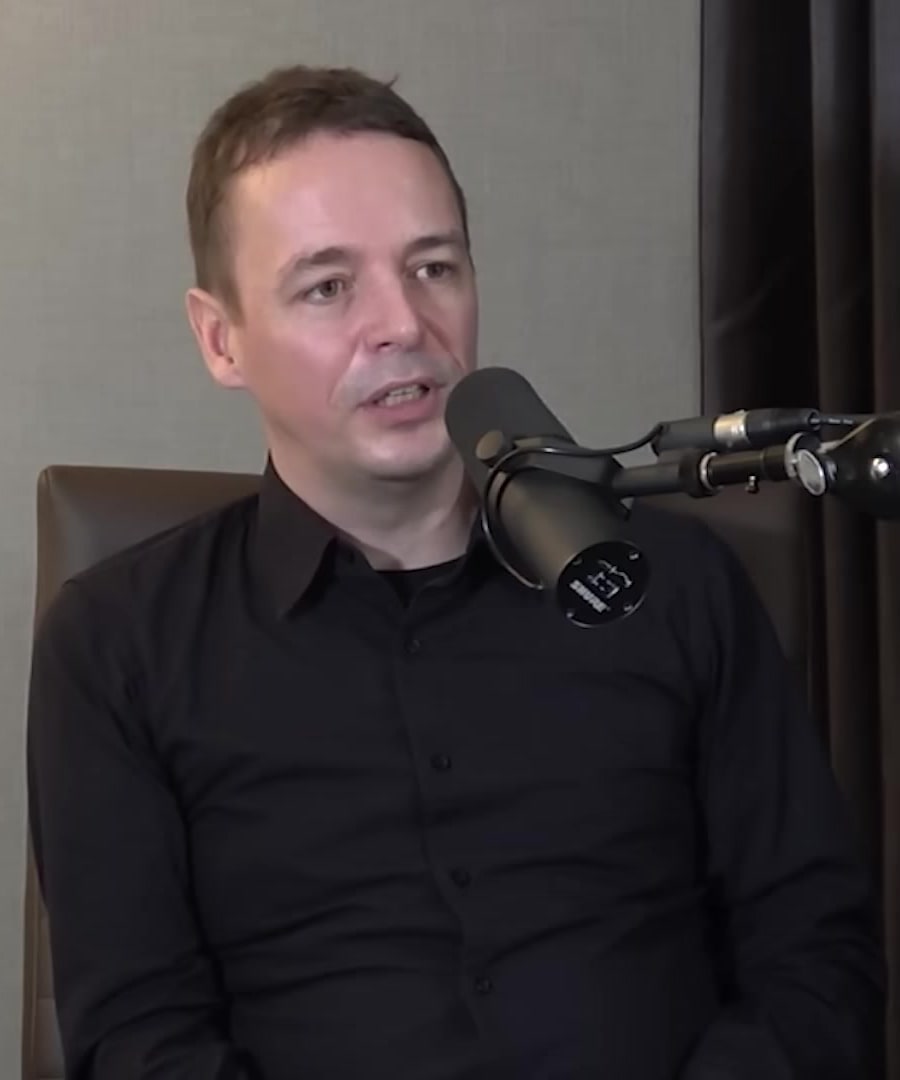
Joscha Bach: Artificial Consciousness and the Nature of Reality | Lex Fridman Podcast #101

Topics covered
Popular Clips




Questions from this episode
- Asked by 220 people
- Asked by 166 people
- Asked by 155 people
- Asked by 126 people
- Asked by 118 people
- Asked by 109 people
- Asked by 95 people
- Asked by 89 people
- Asked by 88 people
- Asked by 87 people
- Asked by 84 people
- Asked by 83 people
- Asked by 77 people
- Asked by 75 people
- Asked by 74 people
Episode Highlights
Intelligence and Attention
explains that intelligence is the ability to model and make sense of patterns, which serves as a foundation for understanding consciousness. He highlights that current AI largely focuses on advanced information processing, automating statistics, and creating models for specific purposes 1. Bach also discusses attentional mechanisms in natural language processing, noting that while transformers can track identity in text, they fall short of fully integrating meaning, which is crucial for consciousness 2.
The attentional mechanism in the transformer model is basically putting its finger on individual concepts and make sure that these concepts pop up later in the text.
--- Joscha Bach
This distinction underscores the complexity of replicating human-like consciousness in AI systems.
Philosophical Perspectives
Bach delves into the philosophical underpinnings of consciousness, contrasting dualism, idealism, and materialism. He explains that dualism posits two substances—mental and physical—interacting by different rules, while idealism views the material world as part of a mind's dream 3. Materialism, on the other hand, sees the physical world as primary, generating models that we perceive as reality. Bach argues that we exist inside a narrative created by our brains, rather than in the physical world itself 4.
We do exist inside of a story that the brain tells itself.
--- Joscha Bach
This narrative-driven existence challenges traditional notions of reality and consciousness.
Simulation Theory
Bach explores the idea of consciousness as a simulation, suggesting that our minds create both the universe and the self as part of a modeling tool. He explains that consciousness emerges from the mind's need to regulate its relationship with the outside world, which consists largely of other organisms 5. This simulation is a multimedia story that our brains continuously write and update, making us virtual persons within it.
Consciousness emerges over dimensions of disagreements with the universe.
--- Joscha Bach
Bach further discusses the 'hard problem' of consciousness, questioning why the simulation feels like something and how stable dynamics in the universe contribute to this phenomenon 6.
Related Episodes


Dr. Lex Fridman: Machines, Creativity & Love | Huberman Lab Podcast #29
Answers 383 questions
How to Expand Your Consciousness | Dr. Christof Koch
Answers 383 questions
Dr. Karl Deisseroth: Understanding & Healing the Mind | Huberman Lab Podcast #26
Answers 383 questions
Dr. David Berson: Your Brain's Logic & Function | Huberman Lab Podcast #50
Answers 383 questionsHow to Optimize Your Brain-Body Function & Health | Huberman Lab Podcast #30
Answers 383 questions
Dr. Terry Sejnowski: How to Improve at Learning Using Neuroscience & AI
Answers 383 questionsHow Your Nervous System Works & Changes | Huberman Lab Podcast #1
Answers 383 questions