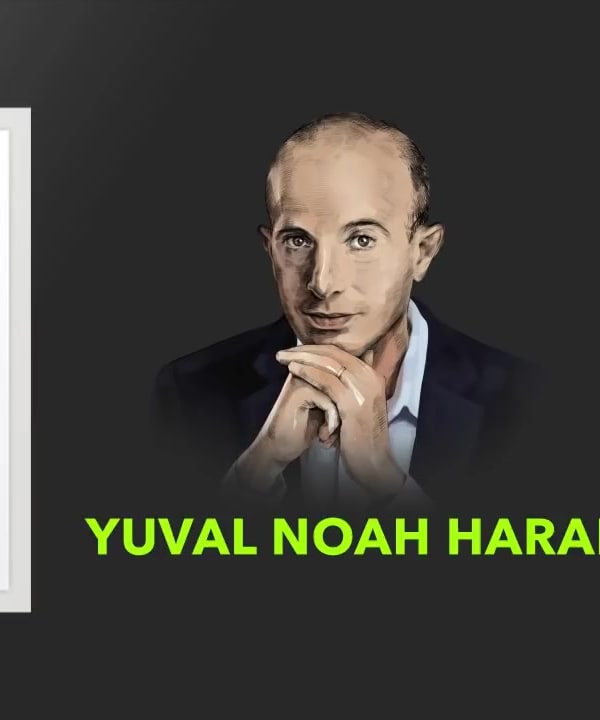
Yuval Noah Harari on The Story of Sapiens, The Power of Awareness, and More | The Tim Ferriss Show

Topics covered
Popular Clips




Questions from this episode
- Asked by 234 people
- Asked by 220 people
- Asked by 115 people
- Asked by 101 people
- Asked by 101 people
- Asked by 92 people
- Asked by 88 people
- Asked by 74 people
- Asked by 65 people
- Asked by 51 people
- Asked by 42 people
- Asked by 37 people
- Asked by 28 people
- Asked by 21 people
Episode Highlights
Future Threats
expresses deep concern over the threats posed by AI and bioengineering, which he considers more complex than nuclear war or climate change. Unlike the latter, where there is a consensus on the need to prevent them, AI and bioengineering are actively pursued by powerful entities without a clear framework for their impact 1. Harari believes that these technologies could lead to the disappearance of Homo sapiens, not through destruction but through profound transformation 2.
The more likely scenario is that it will change humanity in a profound way, that we will use AI and bioengineering to change homo sapiens and to create new kinds of beings.
---
He emphasizes the need for careful consideration of these developments, as they could result in beings vastly different from us.
Inorganic Life
The concept of inorganic life forms represents a monumental shift in the history of life, according to . For billions of years, all life has been organic, but AI could enable the creation of inorganic beings or cyborgs, marking a revolution beyond the rise of mammals or humans 3. Harari warns that such advancements could lead to a downgrade of human qualities, prioritizing efficiency over spiritual depth or sensitivity.
If you leave it to the corporations and armies, it's very likely that once you have a technology to change humans, it will, I would say, downgrade them and not upgrade them.
---
This potential transformation demands vigilance to ensure that technological progress does not compromise essential human traits.
AI and Society
AI's impact on society raises profound questions about human interaction and understanding. argues that while AI may not achieve consciousness, it could predict and respond to human behavior more accurately than people, potentially altering relationships 4. He highlights the allure and danger of AI's ability to understand us better than our closest human connections 5.
What kind of relationships will there be when computers and objects understand you better than the people in your life?
---
This scenario, Harari suggests, is more realistic and imminent than the dystopian visions of robots rebelling, urging society to consider the implications of such technological intimacy.
Related Episodes


Tim Ferriss: How to Learn Better & Create Your Best Future | Huberman Lab Podcast
Answers 383 questions
Ari Wallach: Create Your Ideal Future Using Science-Based Protocols
Answers 383 questions
Dr. Adam Grant: How to Unlock Your Potential, Motivation & Unique Abilities
Answers 383 questionsLIVE EVENT Q&A: Dr. Andrew Huberman Question & Answer in Toronto, ON
Answers 383 questionsTools for Managing Stress & Anxiety | Huberman Lab Podcast #10
Answers 383 questionsHow Your Nervous System Works & Changes | Huberman Lab Podcast #1
Answers 383 questions
Dr. James Hollis: How to Find Your True Purpose & Create Your Best Life
Answers 383 questions
Dr. Karl Deisseroth: Understanding & Healing the Mind | Huberman Lab Podcast #26
Answers 383 questionsThe Science of Vision, Eye Health & Seeing Better | Huberman Lab Podcast #24
Answers 383 questions