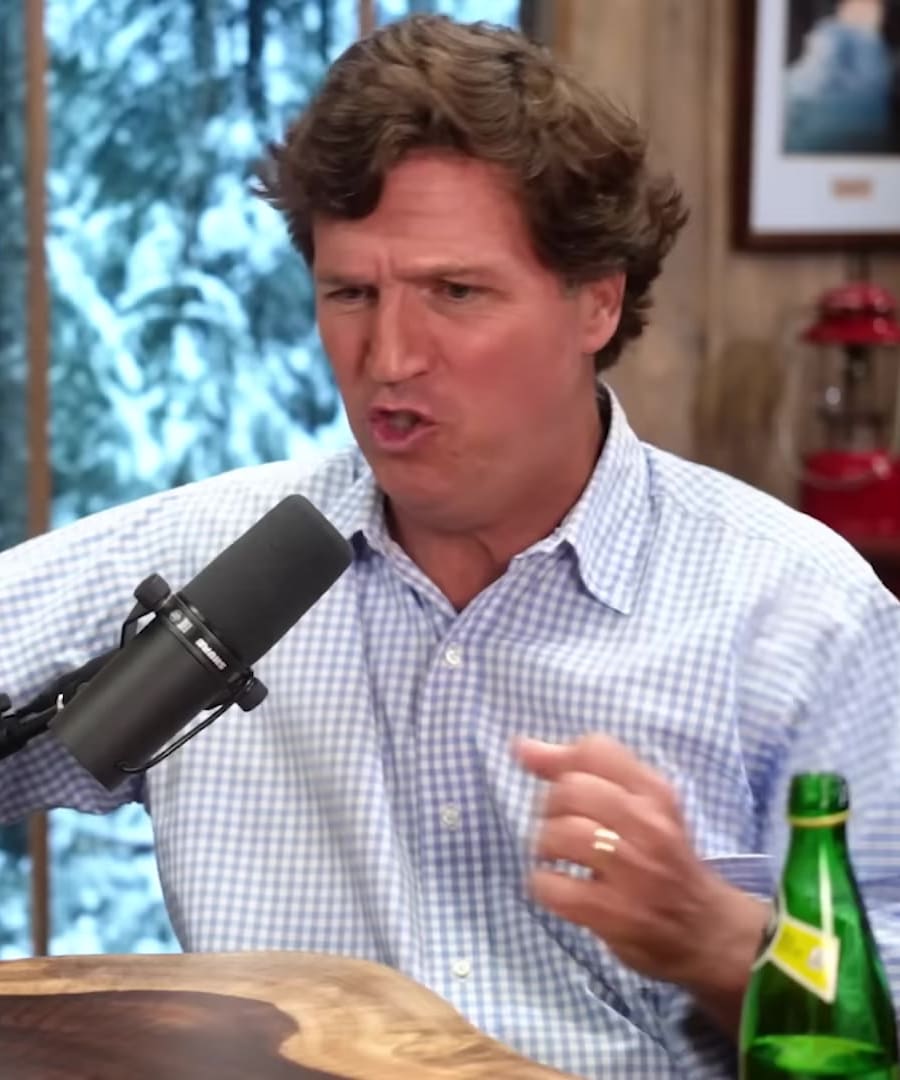
Tucker Carlson: Putin, Navalny, Trump, CIA, NSA, War, Politics & Freedom | Lex Fridman Podcast #414

Topics covered
Popular Clips




Questions from this episode
- Asked by 20 people
- Asked by 7 people
Episode Highlights
Justice System
Tucker Carlson critiques the American justice system, highlighting perceived biases and systemic issues. He argues that the justice system is being used as a political tool, particularly in the case of Donald Trump, where similar charges against different political figures are treated inconsistently 1. Carlson emphasizes the danger of a justice system influenced by political motives, likening it to a system where the Justice Department runs the political landscape 1. He also reflects on the role of intelligence agencies in domestic politics, expressing concern over their influence on democracy 2.
The fact that CIA is playing in domestic politics and actually has for a long time, was involved in the Kennedy assassination, that's not speculation. That's a fact.
---
Carlson's insights reveal a deep skepticism about the integrity of political and judicial processes in the U.S. 3.
Foreign Policy
Carlson offers a scathing critique of American foreign policy, questioning its wisdom and long-term effectiveness. He points to historical failures such as the Iraq War and the prolonged occupation of Afghanistan as evidence of poor leadership and decision-making 4. Carlson also criticizes the U.S. handling of Ukraine, suggesting that American policymakers have misused President Zelensky for their geopolitical ambitions 5. He argues that these actions have not only failed to improve other countries but have also led to unnecessary conflicts 6.
I don't think you can overstate the lack of wisdom, weakness, short term thinking of American foreign policy leadership.
---
His analysis underscores a belief that U.S. foreign policy is driven more by self-interest than by genuine efforts to promote global stability.
Election Dynamics
The discussion on election dynamics in the U.S. reveals Carlson's concerns about systemic failures and political disillusionment. He highlights the influence of money and monopolies in politics, arguing that these factors overshadow genuine democratic processes 7. Carlson reflects on the 2020 election, expressing skepticism about the integrity of the process and the role of media narratives in shaping public perception 8. He also touches on the emotional intensity of political debates, suggesting that they often lead to disappointment and bitterness 9.
If you can take out a presidential candidate on a fake charge, use the justice system to take the guy out of the race, then we don't have a representative democracy anymore.
---
Carlson's insights suggest a need for a more transparent and fair electoral system to restore public trust.
Related Episodes


Dr. Lex Fridman: Machines, Creativity & Love | Huberman Lab Podcast #29
Answers 383 questions
Dr. Jordan Peterson: How to Best Guide Your Life Decisions & Path
Answers 383 questions
Chris Voss: How to Succeed at Hard Conversations | Huberman Lab Podcast
Answers 383 questionsTools for Managing Stress & Anxiety | Huberman Lab Podcast #10
Answers 383 questions
Coleman Ruiz: Overcoming Physical & Emotional Challenges
Answers 383 questions
Rick Rubin: How to Access Your Creativity | Huberman Lab Podcast
Answers 383 questions
Dr. Karl Deisseroth: Understanding & Healing the Mind | Huberman Lab Podcast #26
Answers 383 questions
How to Make Yourself Unbreakable | DJ Shipley
Answers 383 questions
Esther Perel: How to Find, Build & Maintain Healthy Romantic Relationships
Answers 383 questionsRick Rubin: Protocols to Access Creative Energy and Process
Answers 383 questions
Tim Ferriss: How to Learn Better & Create Your Best Future | Huberman Lab Podcast
Answers 383 questionsHow to Optimize Your Water Quality & Intake for Health | Huberman Lab Podcast
Answers 383 questions