286‒Journal club with Andrew Huberman: light exposure on mental health & an immunotherapy for cancer

Topics covered
Popular Clips












Episode Highlights
Circadian Rhythms
emphasizes the importance of minimizing light exposure at night to maintain optimal circadian rhythms. He explains that exposure to light at night can disrupt sleep and negatively impact mental health, citing studies from the Stanford sleep lab. Huberman also highlights the evolutionary significance of light exposure, noting that our circadian clocks are regulated by the contrast between blue and orange light seen during sunrise and sunset 1 2.
The goal should be to minimize light exposure at night.
---
Understanding these mechanisms can help us better manage our sleep and overall health.
Mental Health
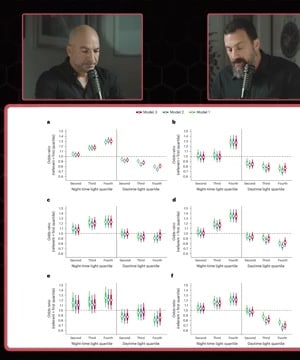
Light exposure plays a crucial role in mental health, with both daytime light and nighttime darkness being essential. explains that specific cells in the retina respond to different types of light and send signals to the brain's circadian clock, influencing mood and hormone release. He notes that bright daytime light is correlated with elevated mood, while nighttime light exposure can increase the risk of psychiatric disorders 3 4.
Light exposure to the eyes is what's relevant here.
---
These findings underscore the importance of managing light exposure to support mental health.
Practical Tips
Huberman offers practical advice for optimizing light exposure to improve sleep and mental health. He recommends viewing low solar angle sunlight in the morning and evening to stabilize the circadian clock. Additionally, he suggests getting as much bright light as possible during the day and minimizing artificial light exposure at night 5 6.
View low solar angle sunlight early in the day, view solar angle sunlight later in the day, and get as much bright light in our eyes as we safely can.
---
These strategies can help maintain a stable sleep-wake cycle and support overall well-being.
Related Episodes

Using Science to Optimize Sleep, Learning & Metabolism | Huberman Lab Podcast #3
Answers 383 questionsLIVE EVENT Q&A: Dr. Andrew Huberman Question & Answer in Toronto, ON
Answers 383 questionsLIVE EVENT Q&A: Dr. Andrew Huberman at the ICC Sydney Theatre
Answers 383 questionsAMA #14: 2023 Philanthropy, Evening Routine, Light Therapy, Health Metrics & More
Answers 383 questionsThe Science & Health Benefits of Deliberate Heat Exposure | Huberman Lab Podcast #69
Answers 383 questions
Dr. Karl Deisseroth: Understanding & Healing the Mind | Huberman Lab Podcast #26
Answers 383 questionsUsing Your Nervous System to Enhance Your Immune System | Huberman Lab Podcast #44
Answers 383 questionsThe Science of Vision, Eye Health & Seeing Better | Huberman Lab Podcast #24
Answers 383 questionsScience-Based Tools for Increasing Happiness | Huberman Lab Podcast #98
Answers 383 questionsLIVE EVENT Q&A: Dr. Andrew Huberman at the Sydney Opera House
Answers 383 questions