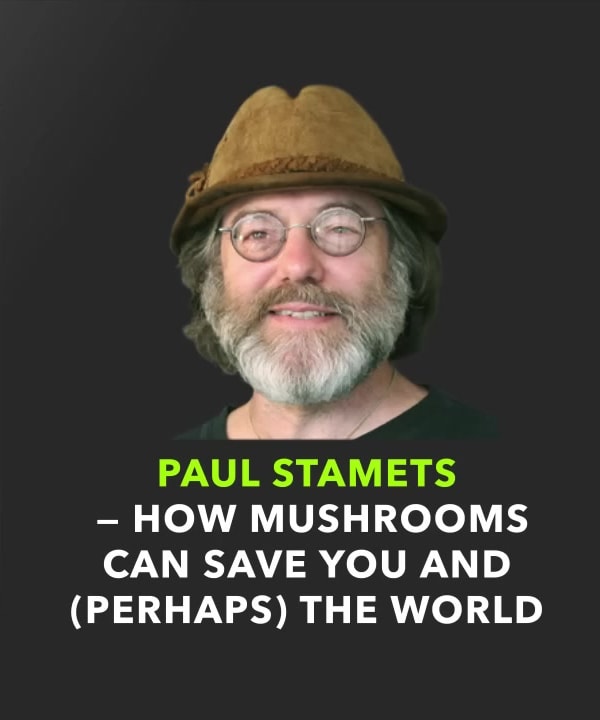
Paul Stamets — How Mushrooms Can Save You and (Perhaps) the World | The Tim Ferriss Show (Podcast)

Topics covered
Popular Clips


Questions from this episode
- Asked by 825 people
- Asked by 227 people
- Asked by 121 people
- Asked by 108 people
- Asked by 95 people
- Asked by 56 people
- Asked by 53 people
- Asked by 46 people
- Asked by 45 people
- Asked by 37 people
- Asked by 28 people
- Asked by 27 people
- Asked by 9 people
Episode Highlights
Restoration Potential
highlights the transformative potential of mycelium in ecological restoration. He explains how mycelium can significantly reduce harmful viruses, such as the Lake Finai virus, by over 45,000 times, and even double the lifespan of bees 1. This underscores mycelium's role in controlling microbiomes and supporting ecosystem health. shares an inspiring story of a Syrian refugee using mushroom cultivation to empower over 1,000 people in camps, illustrating mycelium's foundational role in food security 2.
The mycelium is the foundation of the food web. It is essential for food biosecurity.
---
These examples demonstrate mycelium's capacity to offer scalable, sustainable solutions to ecological challenges.
Sustainability
Fungi play a crucial role in maintaining biodiversity and promoting sustainability. suggests simple actions like allowing wood to rot naturally, which supports microbiome biodiversity and aids in bee health 3. He also discusses the potential of mycelium-based solutions for pest control, highlighting its effectiveness against various insects without harming the environment 4.
Supporting biodiverse landscapes helps plants grow without the need for external inputs like fertilizers.
---
These insights emphasize the importance of embracing natural solutions to foster ecological balance.
Mycelial Networks
Mycelial networks are vital to Earth's ecosystems, acting as a vast underground web that supports plant and animal health. describes mycelium as the largest organism on the planet, with a single cell layer that withstands microbial challenges 5. This network's evolutionary journey began over 650 million years ago, highlighting its ancient and integral role in nature 6.
The mycelium had its form long before we've had ours.
---
Understanding these networks can lead to breakthroughs in ecological and biological sciences.
Related Episodes


Tim Ferriss: How to Learn Better & Create Your Best Future | Huberman Lab Podcast
Answers 383 questionsThe Science of How to Optimize Testosterone & Estrogen | Huberman Lab Podcast #15
Answers 383 questionsHow to Increase Your Willpower & Tenacity | Huberman Lab Podcast
Answers 383 questions
How to Improve Your Vitality & Heal From Disease | Dr. Mark Hyman
Answers 383 questions
Dr. Rhonda Patrick: Micronutrients for Health & Longevity | Huberman Lab Podcast #70
Answers 383 questionsHow To Build Endurance In Your Brain & Body | Huberman Lab Podcast #23
Answers 383 questionsThe Science of Healthy Hair, Hair Loss and How to Regrow Hair | Huberman Lab Podcast
Answers 383 questions
Dr. Paul Conti: How to Improve Your Mental Health | Huberman Lab Guest Series
Answers 383 questionsHow to Optimize Fertility in Males & Females | Huberman Lab Podcast
Answers 383 questions