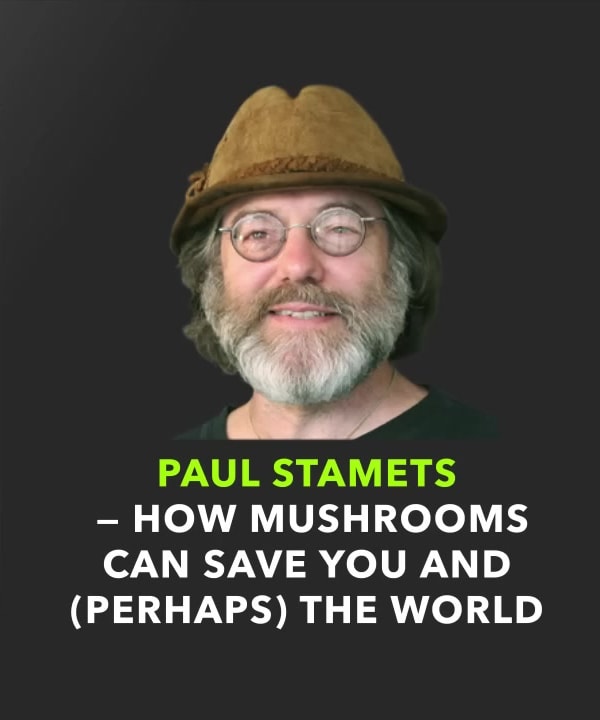
Paul Stamets — How Mushrooms Can Save You and (Perhaps) the World | The Tim Ferriss Show (Podcast)

Topics covered
Popular Clips


Questions from this episode
- Asked by 825 people
- Asked by 227 people
- Asked by 121 people
- Asked by 108 people
- Asked by 95 people
- Asked by 56 people
- Asked by 53 people
- Asked by 46 people
- Asked by 45 people
- Asked by 37 people
- Asked by 28 people
- Asked by 27 people
- Asked by 9 people
Episode Highlights
Bee Innovations
Paul Stamets shares groundbreaking innovations in beekeeping, using fungi to enhance bee health and productivity. His research with mycelial extracts from polypore mushrooms has shown remarkable results, reducing viruses in bees by thousands of times and doubling their lifespan. Stamets emphasizes the potential of these natural solutions, stating,
I can make the argument that natural products can be more powerful than pharmaceuticals with a greater BioShield of defense, with less toxicity and more utility in a sustainable way.
---
These findings highlight the profound role of fungi in ecological systems, offering scalable and sustainable solutions for bee conservation 1 2.
Virus Mitigation
The role of fungal extracts in mitigating viruses that threaten bee populations is a significant focus of Stamets' work. He identifies the Varroa mite as a major vector for viruses affecting bees globally, leading to a viral pandemic among bee populations. Stamets explains,
The loss of bees is such an important issue, and interestingly, it's the number one bridge issue between liberals and conservatives.
---
His research suggests that fungal extracts can offer a natural and effective solution to this crisis, potentially reversing the decline in bee populations and ensuring food biosecurity 3 4.
Ecological Impact
The ecological implications of using fungi to manage bee populations extend beyond individual hives, impacting environmental resilience and agriculture. Stamets discusses how the decline in bee populations affects food production, noting that 35% of our food is directly dependent on bee pollination. He reflects on the broader environmental impact, stating,
Factors which are strung together at the end of the equation means health or disease.
---
By addressing these issues through fungal solutions, Stamets offers a vision of ecological balance and sustainability, emphasizing the interconnectedness of all living systems 5 6.
Related Episodes


Tim Ferriss: How to Learn Better & Create Your Best Future | Huberman Lab Podcast
Answers 383 questionsThe Science of How to Optimize Testosterone & Estrogen | Huberman Lab Podcast #15
Answers 383 questionsHow to Increase Your Willpower & Tenacity | Huberman Lab Podcast
Answers 383 questions
How to Improve Your Vitality & Heal From Disease | Dr. Mark Hyman
Answers 383 questions
Dr. Rhonda Patrick: Micronutrients for Health & Longevity | Huberman Lab Podcast #70
Answers 383 questionsHow To Build Endurance In Your Brain & Body | Huberman Lab Podcast #23
Answers 383 questionsThe Science of Healthy Hair, Hair Loss and How to Regrow Hair | Huberman Lab Podcast
Answers 383 questions
Dr. Paul Conti: How to Improve Your Mental Health | Huberman Lab Guest Series
Answers 383 questionsHow to Optimize Fertility in Males & Females | Huberman Lab Podcast
Answers 383 questions